Friday, January 21, 2011

Speekee-TOS

I have never been a fan of time travel.  You end up spending your time thinking about what should've, could've, would've, instead of experiencing this daily life you already have.  And if you could time travel, imagine all the new decisions you would face; what do you change, (after all, why relive the past if you can't change it) and what consequences is it going to have?  There is also the dread of knowing what is going to happen.  All the life would be sucked out of life.

With that being said, sometimes I do get a little wistful.  And Speekee, a Spanish program for younger kids, is definitely a wistfulness instigator.

When Dragonette was 2, she was already a master of the English language.  She could talk your ear off and if that got old, was not beyond reading your other ear off.  So I, her earless mother, was always on the look out for something to pour into that head of hers.  I tried to interest her in French, after all, I had taken four years of it in high school and her father had taken two, so I figured we could handle the basics. But that stubborn streak (I won't mention where she got that) was a mile long and dear little Dragonette insisted upon Spanish.

Now let me just begin that a decade ago in a small town NE town in Ohio, Spanish was not in abundance.  Not in the stores, nor the population, and definitely not the library.  The few videos available were, to a 2 year old, insipid.  Needless to say, other than what Dora the Explorer taught, Dragonette did not learn Spanish.

What I would have done if SpeekeeTV had been available to us like it was these last few months!  Imagine a Sesame Street that teaches Spanish instead of English.  Complete with puppets, kids, colors, numbers, subtitles in English and Spanish, and catchy songs.
Speekee, Dino, and Lupi

Speekee is program that currently has 10 episodes that are 15-20 minutes long. There is a host puppet, Speekee, along with sock puppets Lupi and Dino, a human man named Jim, and a cast of human kids.  There is a loose format to each episode, where opening and closing songs are sung, along with visiting a new place each episode (the store, the playground, the zoo, the school, etc.)  Vocabulary is covered for each place, as is a review of numbers, colors, and vocabulary from earlier episodes.  Common phrases (like "Where are we going") are used repetitively and everything is captioned on your computer screen in English and Spanish.  That is very convenient for visual learners who need to see what is being said, and for parents who don't have a clue about Spanish.
10 episodes available

Activities to download/print
But what really sets this program apart is the activities found with each episode.  There are not only recipes and activities you can try, but worksheets to reinforce what is being said.  Some writing, some drawing, some coloring, but most importantly, you are learning how to write the language as you learn it.  I wish high school language classes had been this fun.

Now the suggested ages for this program is 2-10 years old.  I don't have any little littles around anymore, but I signed up for this program because Dragonette has finally got her wish and is enrolled in Spanish 1 and I was intrigued about what she would think about the songs.

We started watch on the computer, but four of us crowded around the monitor is not a pretty sight.  We were thrilled when the Wii option was added, as watching on our TV was much more comfortable. On the Wii, Speekee was more challenging, as there were no subtitles.  This would be true immersion for first time viewing, or a good way to test if you really are picking up the Spanish. If I had young children, I would have definitely let this run often during the day, but as a family with older kids, we often found ourself waiting for Dad to get home so we could watch as a family.  What other puppets do you know that inspire a whole family to sit down and watch?

Speekee and Jim
I like the puppets; I like that it is not dumbed down; I like the subtitles; I like the worksheets; but most of all, I love the songs.  All four of us walk around the house singing these ditties because they get stuck in your head. My Latin learner and my jobsite Spanish speaker are totally into it with Dragonette, and are always having to coach poor Mom, who gets her English, French, and now Spanish very, very jumbled in her head.

So if I had a time machine, I would definitely take Speekee back to that small NE Ohio town's library and deal with the consequences. 

Speekee is available in 2 formats, DVD and streaming (SpeekeeTV).

DVD
  • The Speekee DVDs are produced in Europe and use the PAL format for colour encoding. US / Canadian systems use the NTSC format as standard. Many, but not all, North American DVD players are capable of playing PAL media. If you are based in North America, please check your equipment before purchase. Alternatively, subscribe for Speekee TV
  • 4 DVD video discs, 34-track audio CD plus 70 page guide
  • 30 money-back guarantee
  • The price is in British pounds (95.00) so your price will depend on the current exchange rate
Speekee TV
  • All 10 episodes plus the activities
  • can be streamed on your computer with the subtitles or through your Wii's Internet channel without the subtitles (great for practicing to see if you really know what is going on)
  • can subscribe monthly for $7.50 and yearly for $75.00
There is a free two week trial for SpeekeeTV.  You do have to enter your credit card number, but customer service has been excellent for the Review Crew, and not only put prices in American dollars with a yearly option at our request, but also talked to their tech guy and within a few days of being asked, had figured out how to make SpeekeeTV available on the Wii. I have very high praise for their attention to their customers' concerns.

    Thursday, January 20, 2011

    Old Fashioned or Old Fogey

    More and more, I am feeling very old fashioned.  Not Little House on the Prairie old fashioned, although I have daydreamed of living on my 140 acres off the grid, but old fogey old fashioned.  I like my news 7 days a week in my paper box on the street, listen to "oldies" from the 90's, and watch TV shows on Netflix way more than broadcast TV.

    But it wasn't always this way.  I got my first computer when I was 17, a Zeos that only showed orange on the screen.  I used shareware to type things up for school and I jumped onto the 'net  a computer or two later with dial up about 1994.  I had two VCR's (both 4-headed!) for dubbing tapes and a camcorder that used VHS-C so you could stick the tapes straight into the VCR.

    Today, I am a die hard fan of email, am subscribed to over 20 email loops, and spent two hours this December just to organize my bookmarks.  I started blogging in June for TOS and I joined Facebook reluctantly in November, after finding out it was the way to find out what my 27 first cousins and all their offspring are up to.  While I have a cell phone (I know homeschool moms that don't), the only smartness my phone has is to call the people that I tell it to.

    So I guess my whole point here is that even though I don't Tweet and Facebook my every move, I am still in the loop.

    Using my old fashioned methods, I am in touch with thousands of homeschoolers, locally and internationally.  I can suggest a curriculum or answer a question, without a stat counter or a blog follower.  I can tell you what worked and what didn't for us and our learning styles, tell you about new books, sites, and products I have heard about and who liked/didn't like them.  I can answer questions precisely and in real time, without you having to subscribe to something that might talk about everything else except what you had a question about.

    Today's world is so full of people wanting to tell me what they think before I even ask. With 20 minutes of commercials in every hour of programming, news channels that blow everything out of proportion, reality shows about anything but reality, web ads targeted to you, and a mailbox full of things I supposedly need, I cannot be the only one who values being able to ask before I get an answer.
       
    In other words, don't discount us old guys and our old fashioned ways.  We may snoop out the latest, and network it with thousands of people, quickly and concisely, in ways that cannot be measured by the latest google gadget.

    New Year, New Things

    I am fairly new to this blogging thing as it was thrust upon me if I wanted to take part in the TOS Review Crew.  The latest mandate from the powers that be is that I must have 4 posts a month, even if I do not have 4 products to review each month.  So I have been kicking this around, trying to decide what to do, without boring y'all and taking up your time with a bunch of drivel.

    I wanted to add a page, similar to the Books We Like page, to keep the TOS review separate from my own adventures.  However, if I divide things up that way, those posts do not end up in the Archives, but instead are just a list.  If any of my technology gifted readers out there have a suggestion, I am all ears, even though it does make me look kinda funny. But gravity is helping with that already.

    In the meantime, it looks like I am just going to have to mix things up willy nilly.  So from now on, if a post is for The Old Schoolhouse Magazine Review Crew (TOS), it will say so in the header and my disclaimer will apply.  Otherwise, I will have received nothing for my opinion, except completing that four post minimum, and maybe losing the two cents I am sharing.

    Wednesday, January 12, 2011

    Virtual Nerd


    There is nothing like a being a mother to remind you that your brain has a limited capacity.  I used to be a fairly smart person, but for a few years my brain was full of things that the ordinary person did not want to talk about (diapers, potty training, tantrums, etc).  I was well read on the subjects, but had no one to engage in discussions with other than those I was practicing my knowledge on.  Now that my children are older, I am starting to have glimmers of the person I used to be.  Random facts come out of the blue and I have no idea where I learned it or why it has not been accessible for 15 years.  Just last week I realized that I really did know how to find the square root of 56.  Who knew! And I can still string together French words into sentences!  It is a very exciting time in my life, as I work on regaining my brain, although my kids think I am really losing it instead.

    One of the most wondrous things about the human brain is how it catalogs its knowledge.  Its search engine is un-replicated.   Memories are cataloged under sights, sounds, tastes, smells.  It can jump from one topic to another to another, till you forget where you started.  It can interact with other brains by a variety of languages, artwork, chemical pheromones, and body movement.

    So imagine when a parent is interacting with another brain and they are trying to recall something that was cataloged in their head 20 years before, and the frustration when they try to rely on tools invented by other humans to jog their memories. The tools want specific input and will only return specific output.  The tools do not understand how the human brain works and its associations.  Nor do they understand that a human brain can have parts of the solution and need the other parts found and returned to complete the whole memory.

    The ability to relate one topic to another and to another until understanding is complete is what makes Virtual Nerd, a new web based math assistance program, different.  Its input and output comes in many different forms and allows you to wander all over within a topic, until you find all the pieces you are missing.

    Let's look at input.

    With Virtual Nerd, you can search for Pre-Algebra, Algebra 1 or 2, or Physics topics.  You can do this by keyword, an interactive flow chart, or in the case of Algebra 1, by the contents of 4 different math texts.

    Once you get in the ballpark of what you need answers about, you chose a topic, and are taken to a screen that is divided into three parts.

    The output for the chosen topic is in visual and auditory forms.  It is also search-able and relates itself to many other topics. 

    The Video:
    • uncluttered
    • readable handwriting
    • instructor is very well spoken
    • good volume
    The Diagram:
    • computer font
    • covers same info as video without extra written prompts found on white board
    • uses different colors for emphasis
    • writes entire worked problem neatly and succinctly
    • hover your mouse over this box and another pops up with related topics and definitions
    The Step-by-Step
    • a written script or "closed captioning" for the video
    • uses different colors for emphasis
    • fast forwarding and rewinding available by scrolling and clicking
    • hover your mouse over this box and another pops up with related topics and definitions

    This program is different from other math programs I have seen, because it has no limit of moving you sideways through a topic, giving you easy access to layers of instruction for each step made in a problem.  This effect is very similar to the human brain and how one thing can remind you of another....and another......

    I did find the keyword search at times to be not as detailed as I would like and sometimes it would bring up more subjects than I wanted to wade through.  I found the textbook searches to work best, even though we were not using one of the text books listed, when looking up a subject from a text book that Dragonette needed a clearer explanation of.

    I have very high praise for the woman on the videos.  I had no problems understanding her and she had no distracting "umms" or pauses, or mistakes while writing.  She obviously memorized the script and feeds it back to us flawlessly.

    This is not a full teaching curriculum and is not meant to be.  It is instead a tutoring tool that was created by two guys who wanted to share their love of math effectively.  The company has plans to add practice problems, quizzes, and the ability to get feedback along with more Physics, Chemistry, Pre-Calculus, and Calculus.

    The company offers a variety of pricing plans.

    1 day = $5
    1 week = $19
    1 month = $49
    3 months = $129

    The company also offers a 2 hour free trial and a free membership to educators at accredited institutions.

    I think that if you are struggling with math, this program could be very helpful.  It is a powerful and intuitive tutoring tool, and is probably cheaper and less logistically challenging than hiring a tutor.  It could also be used for review before a big test.  But at our house, paying monthly for this service would absolutely break our homeschooling budget.

    I would like to see this company develop a pricing compromise for homeschoolers.  While I understand they are hoping teachers at accredited institutions will advertise their service to their students and provide them with free access to try out the program, I don't feel it is fair to lump homeschoolers in with the general public, since we not only pay taxes to support local school, but then turn around and pay again to educate our own children with no tax breaks, usually on one income.  Perhaps while the company is expanding its offerings, it will also research the homeschool market and learn about our needs, too.  To stay afloat in the competitive market of math helps, it would behoove them to befriend the homeschool community instead of using us to fund free services for teachers at accredited institutions and their families.

    I hope the company takes homeschoolers' needs in mind, as they have an excellent product that is well presented.

    Friday, December 17, 2010

    Tiny Planets

    When Dragonette was a young young'un, she was obsessed with cats.  So much so, I toyed with the idea of writing my own math curriculum with cats on every page and as characters in every word problem, just to get Dragonete to pay any attention to what I was saying about things she had no use for.  But I then came to my right mind, as I did not have that much time or that much printer ink.

    Over the years she has had many "obsessions" with characters she came across and was always infinitely more interested in what they had to say than what I did.  And so, as the adaptable mother I am, I learned to use these "obsessions" to my advantage. That, I think, is where Tiny Planets, a web-based world with a science backdrop comes in.  Tiny Planets is really a series of websites all linked with the common theme of space.  There are 6 places you can visit, each with different activities.
    • My Tiny Planets is an online community and virtual world that combines social elements and gaming to create an engaging fictional outer-space exploration experience. Children adopt and care for their own planet, solve galactic missions with Bing and Bong, sharpen their wits with fast-paced mini-games, navigate their spaceships and avoid wormholes, nurture exotic plants in a biodome, recycle and collect water during rainstorms, help keep neighboring planets clean, all the while racking up achievements and special badges for their accomplishments.
    • On Tiny Planets Fun your child can take a few moments to enjoy brainy puzzle games (like fractions, sound and seek, and symmetry), as well as coloring books and comics.
    • On Tiny Planets Books you'll find interactive story books for younger children featuring Bing and Bong, their endearing friends the locals and the flockers, and all the planets in the Universe of Tiny Planets.
    • Tiny Planets Learning is the site for parents. Here you'll find lesson plans that include educational activities and science experiments to do at home. Also, you'll see how every episode in the Tiny Planets television series maps to early learning educational goals.
    • Tiny Planets Labs is the playground for things to come! When new games are created, they are put on the labs site to test them out.
    • On Tiny Planets TV you can watch any of the Tiny Planets television episodes. This series was co-created with Sesame Workshop and emphasizes science education and early learning goals, such as social and emotional development, language and literacy, problem-solving and reasoning, knowledge and understanding of our world, and creative development.
    Now I admit, my kids are getting more computer savvy than I am.  So after it took me 10 minutes to figure out how to log in and create cadet accounts, (and they recognized the format immediately from other sites they have been on), I turned this review pretty much over to them and then made them explain everything to me!  (Think impromptu oral report/interrogation!)

    There are free things on the site, things that can be bought with stars that you earn as you play the games, and things that are bought with KEYs, which a parent must purchase with real money. You can upgrade your ship, play a variety of different games, read books, watch videos, and decorate your own planet that you can fly your ship to.

    My kids, ages 10 and 13, find this site okay.  They are really a little old for it and I think it really tops out at about 10.  I think it does have educational value, but not the traditional things you look for.  It teaches logic, stick-with-it-ness, computer savvy-ness, and hand-eye coordination. It encourages reading and math skills (earning stars and buying things).  It is a safe interactive world for kids, with faces and scripts to express what you are thinking and the ability to visit the planets of your invited friends.

    Bing and Bong
    I think this site has potential, but at the time of this review, the site was undergoing some upgrades so it could be buggy.  Some things that were supposed to be available were not, such as Bing and Bong, the main characters, at home for you to visit.  There is currently a parents' blog, but I think a FAQ for parents of younger, less computer-savvy kids would be helpful, to walk them step by step though the world of games and activities for kids.  My kids cut their teeth on educational cd's and were miles ahead of me in understanding the in and outs of this site.

    I think, however, the real benefit to this site is what you, as the parent, can make out of it.  If my kids were buggy about space and loved the Bing and Bong characters, I would be all over this to use for what I wanted to teach them.  If they loved shoot'em up games, I could use it to segue into the other parts of the site where other game skills are used.  If they were early readers, I could use the books to encourage them to read new words.  If math was a bore, I could use the stars for addition and subtraction.  Basically, I would get as creative as I could to tie Tiny Planets in to whatever trouble spot we had, just as I did with cats all those years ago.

    Monday, December 13, 2010

    ALEKS

    Look for special offer below!
    Math is one of those things that elicits a strong reaction.  Most people either love it or hate it.  At our house, it can go either way.  My husband loves it, I am not fond of it, Flower is good at it but doesn't revel in this, and Dragonette loves it or hates it, depending on the curriculum being used.  How's that for a mixed bag?

    My latest assignment was to check out the interactive math program ALEKS - Assessment and Learning in Knowledge Spaces.  While the name ALEKS is catchy, the words it comes from do not explain to me what it is. I had heard of ALEKS, but had never tried it out.

    Click here for a 2 minute tour
    After downloading the plugin, I had to choose which level to assign to each kid.  Even though it is marketed as K-12, it starts with 3rd grade level math and ranges up to Pre-calculus, and then includes a lot of upper level maths like Statistics, test preps, Accounting, and Chemistry.  See list here.  I put Flower in MS LV 6 (I assume this is Middle School Level 6 or 6th grade math).  With Dragonette, I know she is in Algebra 1, but there were three Algebra 1 classes to choose from.  I chose Algebra 1 (not CA or Core).  If I guessed horribly, I could change the level at any time.  I also set up an account for me so I could see their progress.

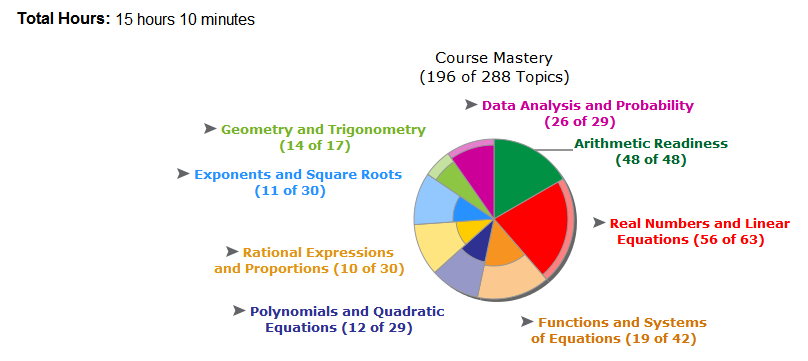
    Each child was then assessed with about 25 questions. They got a pie chart broken into major math topics showing what was learned and what was still to be learned and a bar graph with percentages showing their overall progress.

    Pie Chart for Algebra 1

    After this, they could pick from any topic available (20-30) and if they got the first 2 questions right, it was marked as done.  If they missed any, they then had to get 3 in a row right to move on.  After completing 20 topics they were assessed again.

    If a problem is not understood, the program will show you how to work it and give you another of that type.  Vocabulary definitions are available at a click.  If you have problems using any of the tools they provide to answer the question, a help box is readily available.  Most things were written so my kids understood.  Dragonette did have some trouble with circle equations, so she went back to her old math books to get an alternate explanation.  Flower struggled with the tools for geometry questions and needed Dragonette to help her.

    Notice in this description I said nothing about me.  I can check on their progress.   But otherwise, I have no role except occasional advisor.  The program explains everything.  It decides when a topic is mastered and when to give a test.  I could trip it to give a test when I wanted, but otherwise this was very hands off for me.

    Flower hated the initial assessment. It was long and asked a large range of questions.  She didn't like being asked things she had never been taught to do.  But she did well and tested in at 57% done with this level.  Since our usual math books are not aligned with US standards, it was cool to see where she stood.  I was pleased!

    Dragonette had no problems with the initial assessment and instead saw it as all the cool stuff she still needed to learn.  She loves this program.  Adores it.  Works on it an hour every day she has free.  She can pick and choose the order to work the problems instead of following the sequence of a textbook.  She has a visual cue of what she has done and what is left.  The explanations make a lot of sense to her, and she loves the immediate feedback of whether a problem is right or wrong, instead of doing a set of problems and then looking at the answers.  She initially tested in at 38% done, and in 2 weeks has progressed to 68% and triggered 2 more assessments or tests.  Based on how many topics she is completing per hour used, the program computes she will need 16 more hours complete the program. 
    I can see us adding one more month to our subscription so she can finish Algebra 1.  I think it would hard to work on Geometry with this program, just because the tools used for answering Geometry questions are clunky, but I can see us coming back for Algebra II.

    ALEKS has flexibility in its pricing program for individual families. You receive a student account and a parent account to monitor their progress.

    For one student:
    • $19.95 per month
    • only $99.95 for 6 months!   Six months for the cost of five
    • only $179.95 for 12 months!   Best Deal: You save $59.45
    For more than one student:


    6-Month Term

    12-Month Term
    Number of Students Price Total Discount Off Monthly Rate
    1 $99.95 16.50%
    2 $169.90 29.03%
    3 $239.88 33.20%
    4 $299.84 37.38%
    5 $374.80 37.38%
    6 $449.76 37.38%

    Number of Students Price Total Discount Off Monthly Rate
    1 $179.95 24.83%
    2 $305.90 36.11%
    3 $431.88 39.87%
    4 $539.84 43.63%
    5 $674.80 43.63%
    6 $809.76 43.63%

    ALEKS usually offers a free 1-week trial to try ALEKS out.  But as a special offer, ALEKS will give you one month free instead, if you follow the link in this blog,
    Visit 
ALEKS for 1-Month Trial

    Wednesday, December 1, 2010

    Master Angle

    Angles are very important in our house.  Angles pay our bills, provide us with health insurance and allow me to home school.  But people that do not rely on angles for their livelihood may wonder what the big deal is.  Sure, angles come up in geometry class, but otherwise, who cares?
    Surveying isn't surveying without angles

    Master Innovations is teaching kids grades 1-4 what the big deal is really about with their Master Angle curriculum, which includes a 76 page workbook and a cleverly made full-circle 360 degree protractor.

    At first, I thought no matter how important angles are, how can you fill 76 pages of them for 1-4th graders?  But this book covers a lot of sophisticated geometry vocabulary.  It goes beyond anything my kids have encountered in their math studies, with my oldest half way through algebra, by starting with a point, progressing through nine types of angles, and ending up with chords of a circle.  A handful of vocabulary words are introduced and are followed by various activities to cement the vocabulary and apply the concepts.  The full circle protractor is used to measure and draw angles.   Throughout the book, angles are applied to everyday life in pool tables, clocks, houses, baseball diamonds, and maps.

    For video on how to use full protractor, click here

    Flower (10) enjoyed this book, but thought at times there were too many practice pages for a concept. It was easy to cut some pages out when she understood a topic, and the extra practice was there when she needed it.  But her favorite part was the protractor. With numbers in blue and red, holes for easily drawing angles and a pivoting arm to measure angles, she was fascinated by the number patterns on the protractor. I often caught her playing with those number patterns instead of working in the book.  That alone made the protractor valuable as she was thinking in new directions.


    While the book ($15.95) and the protractor ($5.95) can be bought and used alone, I don't think you would get anywhere near the value you get with them used together. 

    This is by no means a complete curriculum of any kind, but is a great diversion; something fun and different while still learning math.  Master Innovations also makes curriculum for rulers, clocks, and fractions, and a measurement poster.