Friday, October 29, 2010

TOS 2010-2011 High School Planner


In August, I blogged about The Old Schoolhouse Planner (click here).  This is a mammoth book full of sheets to organize and enrich your life.  TOS is going one step further, and they are now making planners that are specialized to different age groups.  This time I got a good look at the e-book The 2010-2011 High School Schoolhouse Planner ($29.00) for this review.

My daughter Dragonette has started high school and so I have researched what I need to do to help her have a successful journey to college.  Beyond the usual topics needed for a high school diploma, I have to teach  time organization, and how to plan to organize her time.  In other words, teaching not only due dates and not procrastinating but how to use an organizer or calendar for organization, and how to coordinate her paperwork with the things running around in her head.

I think this planner is a big step in the right direction.  There is duplication from the original planner, such as Bible reading schedules and book logs.  But this planner leaves out pages a high schooler would not need.  Along with calendars, organizing sheets, and more ways to make a list than you can shake a stick at, there are articles about planning a high school career while looking towards college.  Included is a parent supplement that is a good starting point for learning what questions you need to ask to home school a child through high school.  And because it is an e-book, you can selectively print the pages you need to create a personalized planner for both parents and high schoolers.

Pages that stood out to me:
High School Transcript
Sample Course of Study for College
High School Plan
High School Hours Tracking Log
Books Read this Year (many colleges ask for a books read list)
Classes I Would Like to Create
Vocabulary Study Sheet
Possible Future Plans
Interest and Career Ideas
Extracurricular Activity Schedule

If you are starting your high school journey and have not done the research, the forms in this book will give you an idea of what kind of records you will need to keep.  High school record keeping is not like elementary school record keeping, unless maybe you live in a state with tough homeschooling laws.  Other than math, we have never used boxed curriculum, and it is not unusual for us to create classes by piecing things together from a variety of sources.  That makes my record keeping challenging, because I cannot just list a table of contents and say we did all of the things this book told us to do.  Not only do I need to make sure I hit all the topics in a course, but I need to make sure I document all of the projects, books, and field trips that went into that class.  And since I will need to create transcripts, class descriptions, a books read list, volunteer and extra curricular activity logs, and a school philosophy for college applications, as well as be a mom, teacher, curriculum creator, and guidance counselor to my daughters, I have got to be super organized as soon as we start high school classes instead of waiting until Dragonette's 11th grade year.

The first thing I did was fill out the "Classes I Would Like to Create" sheet.  Each sheet is an interactive pdf, which means I can type my thoughts right into the form and print it out (much more readable than my chicken scratch).  I have seen sheets like this before, but there was something about the format of this particular one that struck a creative chord and allowed me put on paper some ideas that have been swirling in my head.  This was a double bonus, as I checked this off the To Do list and freed up some brain space!

My next task was to use the information in the planner to guide my daughter.  She is now keeping a calendar with due dates and already has a book log.  We have worked on a tentative High School Plan. Next I think I will bring out the Possible Future Plans list.  I don't want to overwhelm her, but I do want her to steadily take her education into her own hands, as she will need these skills in college.

Every home school journey is different, even within a family.  Once high school coursework starts, a home school mom has to be on top of her game.  Perhaps this is why so many home schoolers send the kids to brick and mortar schools for high school, but that has never been an option at our house.  So I appreciate items like The 2010-2011 High School Schoolhouse Planner, because they assist me in planning and presenting my children's very personalized education in a format that any college administrator can understand.

Friday, September 24, 2010

Schleich Animals

Photobucket
Sometimes in our quest to give our kids the best education we can, we forget that curriculum is more than books, math manipulatives, and answer books.  I was reminded of this when I received a box of Schleich figures in the mail.

Schleich is a German company that prides itself on their hand painted, durable, molded figures. The catalog divides the 500+ available figurines into:

World of Nature
    -Wild Life
    - Farm Life
World of History
    - Prehistoric Animals (each of these comes with a booklet of information)
    - The World of Knights
    - The World of American Indians
World of Fantasy
    - Bayala
         - Iloris
         - Arelan
    - The Smurfs (yes, the blue ones from your childhood)

Schleich figures I received (ignore the green patch --that's a homemade saddle)

All the figures we received were from The World of Nature. This includes a gnu, a gnu calf, a horse, a Dartmoor Pony, an okapi, an elephant, a donkey, and a piglet. These figures, while plastic, are a heavy plastic that reminds me of a hard rubber.  The figurines feel solid in your hands, and are balanced to easily stand up.  And unlike cheaper figurines, the eyes are painted in the right place and the markings on the animals are very realistic, including the silver horseshoes on the Dartmoor pony.
Silver horseshoes on Dartmoor Pony

These could easily be played with and inspire the right questions, like "Where does this animal live," or "What is it closely related to," instead of "Why won't this darn animal stand up," or "Why is its eyes crooked," or "Does that color combination really occur in nature?"

I really liked the quality of these animals, and although my kids have mostly outgrown the farm animals, Dragonette was thrilled to see an okapi, a favorite animal of hers that it seems no one else has ever heard of.  My kids were very interested in the Bayala group of figures in the catalog, and I loved seeing the Smurfs, which were a favorite in my house growing up.  So I guess you could say there is a figurine available for all ages in this catalog.

While you can see the full catalog on line, you cannot buy directly from the company.  You can search for a local retailer (for instance, Target and Toys "R" Us) or you can buy them on line (Amazon and a variety of toy stores).

This product is a great way to spark some imagination in your kids, something that is just as important as multiplication tables and parts of speech.

Friday, September 17, 2010

Vocabulary Cartoons

SAT vocabulary is somewhere on the to-do list of every homeschool parent.  New Monic Books has come up with a product to help you cross that item off you list.

Vocabulary Cartoons, SAT Word Power ($12.95 ISBN 9780965242233) is the book I looked at for this review.  It is a 300+ page book of vocabulary fun. Fun?  Yes, fun!

The book is divided into 29 sections.  Each section has 10 words in it, for a total of 290 words.  The 290 words are introduced in alphabetical order which makes looking up a word very easy.  And after every 10 words there is a review page with matching and fill-in-the-blank questions to see what you remember.

Each word gets one page and on that page is
- the word
- the pronunciation
- the part of speech
- the definition

Okay, sounds like a regular old vocabulary book at this point.  But then there is the
- the Link
- the cartoon
- the caption
- the examples

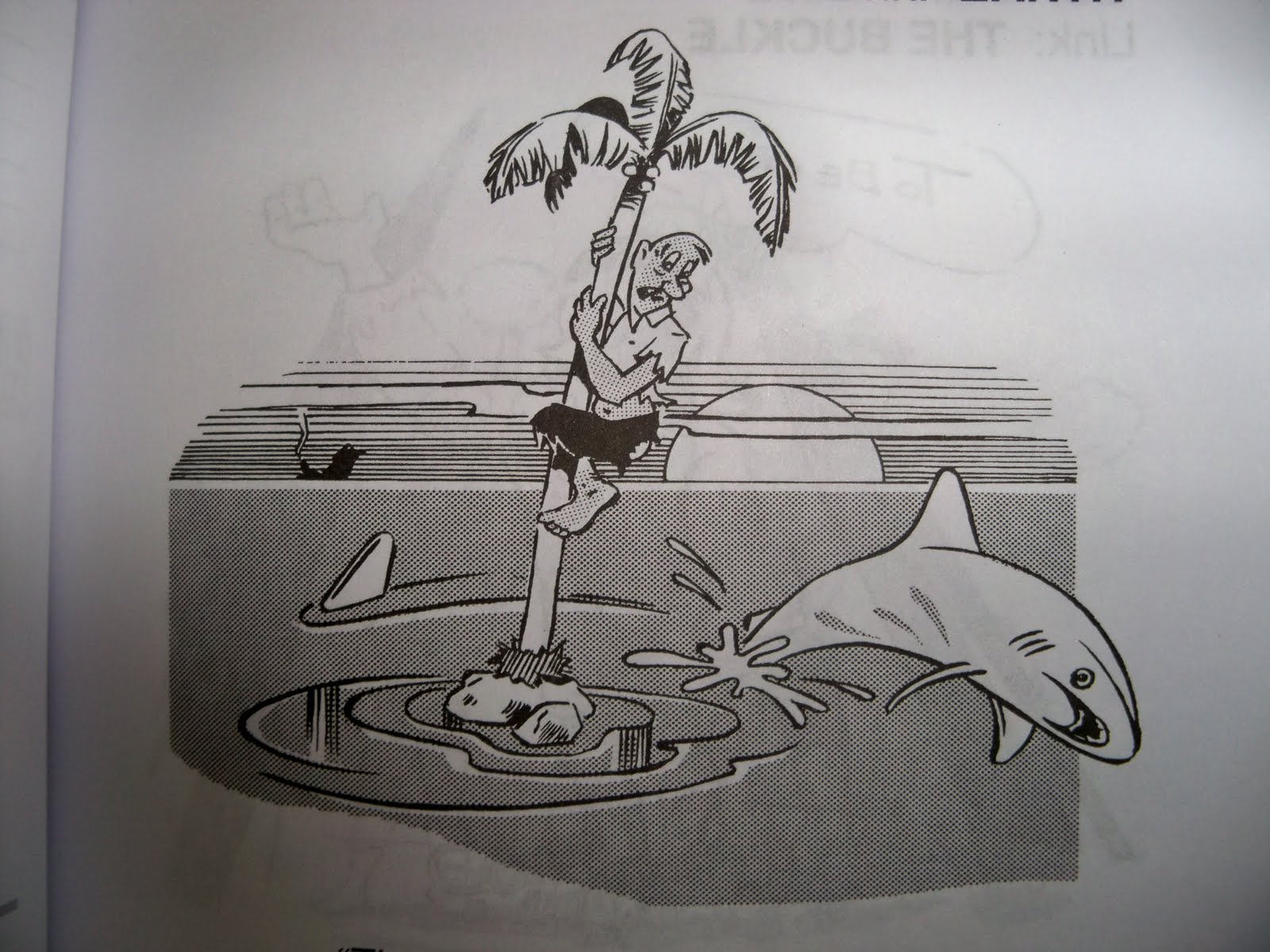
Here is one of the pictures in the book.
The caption for this cartoon is "There is a DEARTH of EARTH in the middle of the ocean."


The Link for this word is earth.  So when I think of dearth, I should think of earth, and this picture or phrase should pop up into my head.

I like this book because the mnemonic devices are sound.  When I was in the 4th grade my teacher used a mnemonic book to teach us the presidents.  I remember Washington was a person washing a ton weight.  And that's it. I cannot recall any of the other pictures and I didn't really learn that list of presidents (other than to regurgitate it for the test) until I taught my kids the list to the tune of "Ten Little Indians"  But, I digress.  The point is, that picture did not tie into the subject matter at all.  But in this book, it does.  There really is a dearth of earth in the middle of the ocean.  Fossils really are docile. A broken down truck would make someone truculent.  But I really doubt Washington ever washed a ton weight.


But as you know, it doesn't just matter that Mom likes a product.  So the book went to Flower, 10, first.  She read the first ten words before bed, and the next afternoon out of the blue I quizzed her using the review page.  She not only remembered the words/definitions, but she could describe each picture and its caption.  I know those words belong to her now.

Dragonette, 13, got the book next.  She has a huge vocabulary, but there were plenty of words she did not know.  And some of the words that she did know had alternate definitions listed in the book that she did not know (fleece = to swindle).  I sent her to try things out.

In typical Dragonette fashion, she sat down and read the book in one evening.  This was perhaps not the best use of this book. :o)  She retained only few words (although she stated she was busy plugging those few new words into her writings).  So I sent her back to read one section a day.  The results for this surprised me.  She could easily recall the definitions and describe the pictures, but she struggled with the Link word and the caption of the picture.  I guess this is a good example of how different learners use this book.

At our house, we have a nice mix of visual and auditory learners and many products do not work well for all of us.  This book does! There are so many things to latch on for each word, a person's brain can choose which device works best for each word.

About the only con I can come with for this book, is that it is not a full vocabulary program.  If you need a lot of review for words, you would need to add in extra practice.

New Monic Books also sells Vocabulary Cartoons, Elementary Edition and Vocabulary Cartoons II, SAT Word Power.  I am looking forward using these too.

Friday, September 10, 2010

America's Math Teacher


Today we are looking at America's Math Teacher, a web based math program.
America's Math Teacher

This program was designed by a math teacher to prepare kids for algebra by reinforcing topics already covered in any math program 4th grade - Algebra with a hybrid of drill and review.

This program has a few different components.
  • Videos - There are 4 levels of web based videos to chose from (Basic Math Skills, Advanced Math Skills, Pre-Algebra Concepts and Algebra). When you subscribe, you have access to all the levels.  This allows you to visit any topic needed for review while organizing the topics into common subjects, helping you to find what you are looking for faster.
  • Worksheets - Each level has its own style of worksheets available to reinforce what was discussed in the video for that day. In the lower levels, there are daily drills on math facts, along with review problems on the topic of the day.
  • Evaluation Center - Timed quizzes and exams to take after each topic is completed, to ensure mastery of the topic   
  • Resource Center - A list of NCTM Standards, worksheets, and speed drills in the same format found on the Basic and Advanced Math worksheets.
In addition to drill, this program does spiral, which means topics come up again and again, adding to the review and reinforcement that is at the heart of this program.

This program could work well if you have many kids to teach or an independent learner.  You can still use your regular math program, but whenever a topic comes up that they can't quite remember, it can be quickly found in this program.  Watch the video, print out a sheet, and try a few problems using that skill.  Many of the programs features are downloaded as pdf files, so you could set folders up for each child, ready for them to open as needed.  This program could also be used as a beginning of the year refresher or a summertime help to retain skills.

At our house, we have tried spiraling programs.  But both of my children are big picture learners.  They need the whole concept introduced without any other topics hanging around.  They get extremely frustrated with bits and pieces.  Because of this big picture learning, they tend to work a long time within a topic, doing harder and harder problems until they own that topic.  Review makes them feel like they are going backwards, instead of continually nibbling small bites of the topic sandwich.  And since this program isn't really designed for introducing topics without a primary instruction source (there is not a lot of "why this works" explanation), I found it very difficult to use this program.  I have spent a lot of tough years understanding how my kids learn math, and deviation from this tends to lead to months of math frustration before we end up back on course.  I tried this program briefly with my kids as instructed by the makers, but within a few lessons I was hearing the familiar frustrations and had to back off.

However, this program could work well if what you need is a drill based spiraling supplement or even just someone impartial to repeat and review topics for you.  It would be especially handy if that explanation is needed when you are busy. 

The Homeschool Memberships for this web based math instruction are priced at $195/year which gives you access to everything on the site. America's Math Teacher

You can also see free samples here.
America's Math Teacher Free Lessons

If a web based math is not what you are looking for, the creator of this program also has print materials available at the Math Essentials website.
Math Essentials

Wednesday, September 1, 2010

Vantage Learning

Everyone has spell check these days and many programs also have a grammar check.  But Vantage Learning's My Access Writing Home Edition takes these ideas a bit further.

My Access Writing is a web based program that can be purchased for 1-3 students ($99.95/yr) or for 4-6 students ($129.95/yr)  Its purpose is to help kids from 8 to 18 learn how to become better writers. My Access Writing Home Edition

Once you sign up, you create custom accounts for each of your children by:
  • Choosing which levels of writing exercises they can have access to (any combination of ages 8-10, 11-14, and 14-18).
  • Picking which topics they can try, which are arranged by style of writing (informative, narrative, and persuasive).  This is customizable at any time.  You can also add your own topics.
  • Assigning a point value to strive for, a deadline, and rewards for reaching the goal.
  • Picking up to 7 email addresses to automatically send weekly progress reports to (think Grandma)
Once you get the accounts set up the way you like them, you can turn your kids loose.  There are two ways they can approach this program.

 ********************************************
1. Be methodical and go through the tutorial on how to use the program. This includes:
  • Course Overview - Explanation of the writing style 
  • Chief Reporter Training - Multi step explanation of writing, its vocabulary, and a quiz Rubric Training - Introduction to using a rubric with another quiz
  • Pre-writing - An interactive graphic organizer 
  • Once you work through the modules (earning points for doing it), you are ready to start writing.
    2. Just jump right in, pick a topic, and start writing. You have:
    • Access to basic word processing tools, such as bold and align left. 
    • "My Outline" provides a place to write an outline or refer to the one you have already made. 
    • "My Checklist" provides a list of things to look for in your writing. 
    • "Writer's Toolbox" includes writing vocabulary and definitions (protagonist, for example) and a cool thesaurus that you can use to bump up the complexity of the words you use. 
    • "Writer's Course" is available if you get stuck and need a quick tutorial.
    ******************************************

    We started out taking the methodical route.  My 13 yo, Dragonette, breezed through the explanations and was off and writing within an hour.  My 10 yo, Flower, did not enjoy such an easy leap into the program.

    I guess I should back up a little here.  At our house, I have not taught a lot of writing, but my kids love to write.  They know about paragraphs and good grammar and whenever I see an issue in their writing, I point it out and use those as our teaching moments.  Dragonette breathes writing and has multiple writing projects always going on.  Flower also writes, but not with the single minded focus that Dragonette has.  So I was honestly curious as to what this program would tell me about their writings.

    Flower got bogged down in the explanations.  So I helped her skip out of them and got her started on her first choice, "My Favorite Pet."  Having never used the 5 paragraph system, she was soon in over her head again.  She said all she felt she needed to say in the first paragraph!  So I backed her up into the outline feature.  Together, we created an outline as prompted by the program and it could be pulled up while she was writing.  Now that she was organized,  it took her very little time to prepare five paragraphs to be edited by the program.

    Now here is the curious part about this program.
    • It grades your writing (below, proficient, advanced) in 6 categories    
                - holistic
                - focus
                - content development
                - organization
                - language style
                - conventions
    • A "Revision Plan" is set up for you with examples and suggestions, like highlighting the main ideas and supporting sentences. This allows you to see how organized your writing is.
    • Once the revision is started, click on  "My Editor" and all the places the program feels you can improve spelling and grammar are highlighted.  You can chose to have these errors pointed out to you in English, Spanish, Chinese, Japanese, Korean, Simplified Chinese, or British English.  This is a great tool for those that are writing in American English as a second language!

    With Dragonette, this did not work well.  There were a lot of false errors in her writing, as she tends to use complicated sentence structure.  Software always has trouble with the English language and its exceptions to the rules, and Dragonette's writing brought out the worst of these false errors.  The program developers do admit this can be a problem, and I concluded that her grammar is beyond what this program can offer.

    But that still leaves Flower.  And despite her trouble with the initial explanations, I found that this program did a good job organizing her to write and finding her errors.  And better yet, surprisingly, I became her ally.  Together, we went through the errors the program found, and schemed how we could outsmart the editor by reworking things.  In the end, her score came up, I was not the bad guy for once, and she learned some new writing skills.

    So overall, if your child is a good writer, you may not be able to use this program to its full potential, other than to use the topics and keep writing assignments organized.  But if you have a child that needs some organizing and loves to fight you, this program may be exactly what you need.

    Saturday, August 14, 2010

    TOS Schoolhouse Planner

    I am a veteran homeschooler.  I have been in the trenches since 1999.  And yesterday was the first time I had ever seen the TOS Schoolhouse Planner.
    TOS 2010 Schoolhouse Planner

    614 pages?  You're kidding, right?  I was immediately overwhelmed.  So I printed out the 13 page Table of Contents that I could curl up on the couch with and peruse.


    Wow.  My first impression was this massive tome was misnamed.  At first I thought it needed to be called "If You Homeschool You Need This Planner"

    There are 293 pages of nothing but ways to make lists!  I am a list maker from way back, but this makes me look like an amateur.  I have lots of things rattling around in my brain that I have thought about putting on a list, and this planner gives me no excuse to not put them on paper.  Not only are there your normal calendars (that you can type on!), but there are lists for car maintenance, freezer contents, convention visits, co-op planning, babysitter sheets, a garden grid, appliance lists, loaned and borrowed lists, website passwords, and on and on and on (all ready to be typed in).

    Okay, we still need a new name.  How about, "If You Are Alive, You Need This Planner" or "Lists to Satisfy the List Maker in You Planner"

    However, this tends to ignore the first 202 pages of this list library.  Here you find 12 months of encouragement and gentle nudging.  Each month has a theme (geography, special needs, food, history and more).  There is an article written about the theme of the month, activities, recipes, links to items at the TOS store and web page links to delve deeper into that month's theme.  If you try to sit down and read this all at once, it is like trying to teach all four years of high school in one.  This section is absolutely meant to be looked at month by month, giving you a theme and encouragement to help make that month more interesting in your school and to maybe give you things to think about that you would not have come up with on your own.

    If I had seen this thing 11 years ago, I could have saved some of my precious brain power for things other than finding organizers to organize my homeschool. This massive library has items I didn't even know I needed.

    59 page sneak peek, including Table of Contents

    TOS, you really need to rename this planner.  If my earlier suggestions don't work for you, how about "If You Are Alive and Have Children, You Need This Planner"

    (I am a member of the TOS Homeschool Crew.  The Planner was given to me so that I could write this advertisement for the Planner, which is a contest entry.)

    Monday, July 19, 2010

    Travel the World TOS June Module


    For my maiden voyage into the sea of curriculum reviews, I investigated the This Old Schoolhouse Magazine's June module, titled Travel the World, available for $7.95 at the This Old Schoolhouse store. This Old Schoolhouse June 2010 Module

    This 52 page e-book is a quick introduction to the world of geography and has activities that can be used for a variety of ages. 

    I have been making an effort to study geography lately at our house, as it is one of those things that often seems to get pushed aside for math and English.  This e-book is a great beginning place because it not only introduces a lot of geography terminology, but has embedded links to definitions, maps, and games to reinforce facts all in one resource.  

    The book begins with basic map reading and geography terminology, such as equator and prime meridian.  It briefly touches on the five oceans with links for further exploration, and then goes on to the continents and their land features.

    Six worksheets are provided for reinforcement.  Only one is the standard fill-in-the-blanks, and all of them differ in format, from word searches to a rebus puzzle.  Seven pages are devoted to making a Travel The World lapbook.  Coloring sheets and copy work pages in printing and cursive round out the main elementary section.

    The high school component of this e-book has a link to a geography challenge and breaks the field of geography into specialties.  There are essay prompts and sections that tie geography into literature, history, and even small business.

    Two recipes are included, along with a page of internet resources and all the answers to the worksheets.

    This e-book would be good for a brief foray into geography with little preparation needed; I think it would have a good home in a family that likes technology, working on the computer, has little physical storage space, and needs things laid out, ready to go.  Unfortunately, that is not quite my family.  We tend to like the solid feel of a book in our hands, and while this e-book can be printed out, you miss all the extras provided by the embedded links.  This also means being tied to a computer with internet access, and since our dinosaur laptop died last year, that also means being tied to a desktop at our house.

    One thing I would liked to have seen is a section describing how you can make a ball (globe) flat (a map), as those kinds of questions always arise in our house and I am always flailing for an answer.  And as the cook in a family with an adventurous palate,  I would also have loved a few more recipes.

    But overall, as a one-stop place to get some geography into your school, this is a great beginning.